GDP has always excluded parent childcare, volunteering and other unpaid work from its calculation. More recently, it has failed to properly account for much of the digital economy. For instance, Facebook is only counted by its advertising revenue ($40 per user per year) but our willingness to pay for the service is much higher at $600 a year. These and other omissions explain why, to quote John F Kennedy, “GDP measures everything except that which makes life worthwhile”.

All Threads
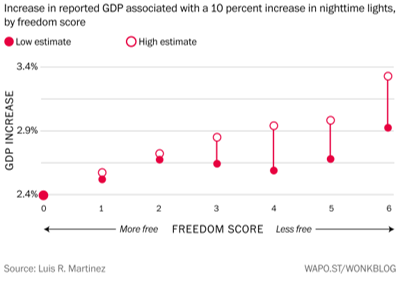
How do you prove that these regimes are inflating their GDP figures? Use satellite data. By tracking changes in nighttime lighting – a measure of consumption and activity that is hard to fake – researchers found a clear link between lack of freedom and inflated figures.
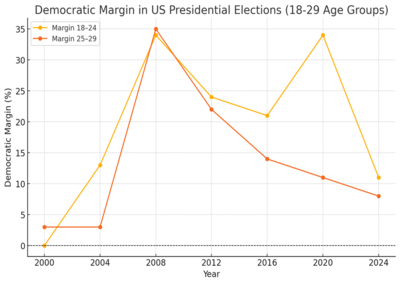
It’s not new to say generations are misleading, but voting behaviour makes it clear to see: in the 2024 US election, Kamala Harris’s winning margin declined by 23 points among 18-24 year olds but only 3 points among 25-29 year olds. Technically, these age groups are both part of Gen Z.
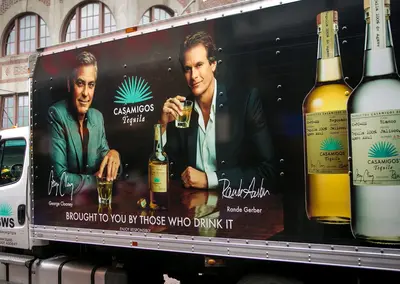
In 2017 George Clooney sold his tequila brand Casamigos for $1 billion, and it became the fastest growing spirit brand of 2022. There’s no doubt it tastes good, but there’s also no doubt his fame contributed to its success. Clooney is one of several celebrities to create a successful alcohol brand; David Beckham & Haig Club, Ryan Reynolds & Aviation, Kendall Jenner & Gin 818 Tequila.
If you think kebabs are for nights out, then think again: only 4% of GDK’s business is done post 11pm – this has been helped by a diversified product range, including healthier options like rice bowls, and an ad campaign designed to showcase its relevance at every meal time.
If you look at an election results map of Germany (in 2025), you can still see the iron curtain that divided communist East Germany from the west. The populist AFD party is dominant in the east, where living standards remain low after decades of communist rule, while it fails to cut through in the more prosperous west.
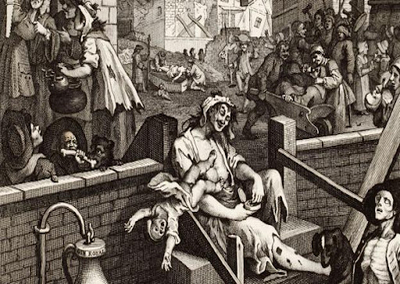
Gin has become increasingly fashionable in the UK, but we’ve been here before: during the ‘gin craze’ of the 1700s the average person was drinking 10 litres of gin each year (vs 2 today), and consumption became so rife that Parliament passed several laws to reduce it.
Anyone who has tried to get Glastonbury tickets knows the chaos involved – manically refreshing the landing page to secure a spot in the queue. Yet fans complained when the festival introduced instead a new system in 2024, which randomly assigned everyone to a place in the queue as shown by green tabs. Yes it was easier and fairer, but it removed the fun of the process that had become an institution in its own right.
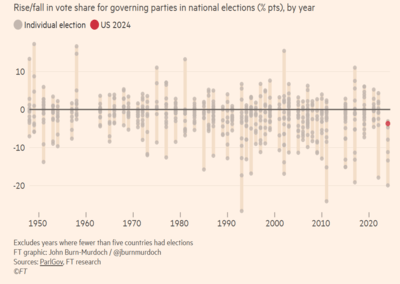
Every governing party facing election in a developed country lost vote share in 2024, the first time this has ever happened.
Billions of people live in extreme poverty with almost no income, but this often feels too abstract to be meaningful. This prompted statistician Anna Rosling to launch Dollar Street, a project that uses photos to showcase the reality of living in poverty. Photographers have documented hundreds of homes in 50 countries so far, and in each home the photographer spends a day taking photos of up to 135 objects – everything from toothbrushes to shoes.
The beauty brand was hailed as a poster child for the DTC model. But now, as Shane O Leary notes, “it has 11 stores and a Sephora partnership is key to recent growth.” Like many brands it is realising that physical stores play a crucial role in brand growth.
The world’s most annoying singer.
Getting home insurance is a serious faff, especially when providers ask you about intricate details you’ve never thought about. But the website GoCompare makes the process more consumer friendly by using visual cues. After all, it’s much easier to recognise your lock from an image than a description.
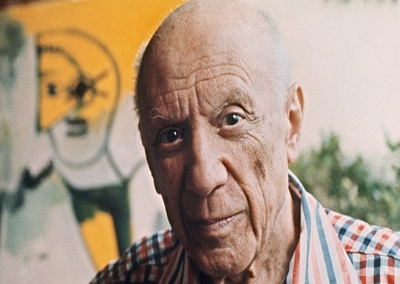
Some of the greatest artists in history – Picasso, Woody Allen, Kanye West – do things that are morally (and legally) wrong. Should we think of them as good or bad? In many cases, the answer is both.
Few people recognise this quote: “whenever a government seeks to rely on a previously observed statistical regularity for control purposes, that regularity will collapse”. But it’s actually the original formation of Goodhart’s Law, as described by economist Charles Goodhart. Thankfully, the law was simplified by anthropologist Marilyn Strathern beyond the world of statistics: “when a measure becomes a target, it ceases to be a good measure.”