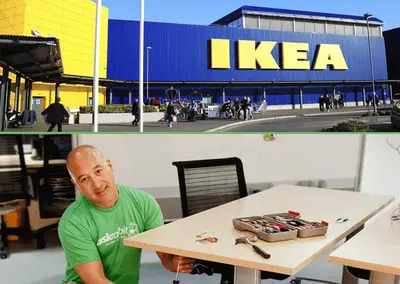
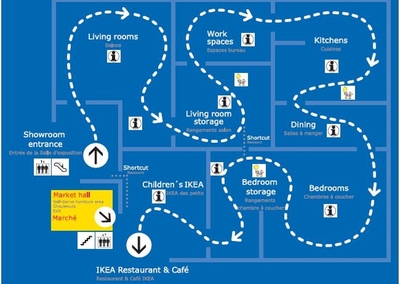
Ikea is almost as famous for its food as its furniture, so in 2024 the retailer capitalised on this; opening a standalone restaurant in London, serving affordable meals as well as its iconic meatballs.

At Ikea, you have to walk through the entire maze-like store to get to the checkout, and if you buy something, you have to assemble it all yourself. Hardly easy, but nowadays how many other stores are people genuinely excited to visit?

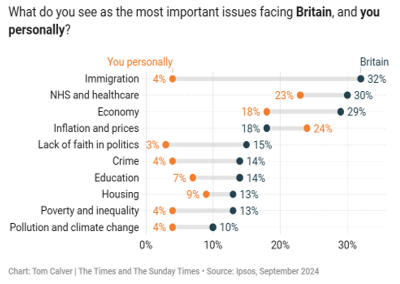
Immigration is the biggest perceived problem facing Britain, but just 4% of people feel it affects them personally. It begs the question, why do people assume it’s such a big issue for others? Interestingly, this pattern holds for all surveyed issues with the exception of inflation – which is considered to be a bigger problem personally vs for the country.

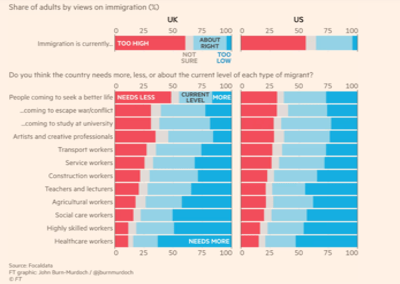
When asked in general terms, most people say that immigration is too high and the government is spending too much money. But the story is more nuanced when it relates to specific examples: the public actually wants more migrants who are highly skilled or in social work. We can’t expect to understand complex topics with generic prompts.

To calculate inflation, the ONS uses a typical basket of goods to work out the rate at which costs are rising – but the average doesn’t reflect most people’s experience. For instance restaurants have a strong weighting on inflation, but they have little impact on elderly people who don’t leave the house. Meanwhile cigarettes have a weak influence on the calculation, but tell that to the chainsmoker who buys a pack a day.

Have you been in an accident that wasn’t your fault?

Contradictions are hardwired into humans. We are natural born worriers – to prevent harm from unknown threats – but we’re also wired for curiosity: a trait that gave our ancestors access to new sources of food, water and tools. This is why we can love and loathe uncertainty, depending on the context.

The food delivery business is slowly becoming an advertising business: a quarter of its revenue comes from brands promoting on its website.

Covid killed the ability to travel overseas, but not the desire to do so. In 2024 a record number of passengers travelled through Heathrow airport (83.9 million), making the need for a third runway greater than ever.

Apple raises the price of its phones with each new model, and yet consumers continue to buy them. To be fair this is also driven by the addition of new product features, and not just price.

When Steve Jobs introduced the first iPod to the world, he didn’t say: “the iPod. A 5GB MP3 player”. He said, “the iPod. 1,000 songs in your pocket.”

In 2002, MI6 revealed new intel that Iraq was stepping up its production of nerve agents – supposedly being loaded into hollow glass spheres. In reality, it was fake intel that was based entirely on the plot of the movie The Rock, starring Sean Connery and Nicholas Cage (glass containers are not in fact used in chemical munitions). This fictional information was being used by the UK government right until the day of the invasion in 2003.

Actually, London gets 562mm per year on average; a bit less than Malta (592mm) and Rome (586mm), and about half of the annual average of Sydney (1,222mm) or New York (1,059mm).

Barclays and E-Trade both use this insight in their advertising, but the latter is more engaging because of the adult voiceovers and the humorous scripts.

Itsu started out as a sushi restaurant, but it’s morphing into a supermarket range: close to half of its revenue now comes from grocery products.